UNIST site map
- Admissions
-
Academics
- Colleges and Schools
-
Academic Affairs
- Academic Calendar
- Academic Curriculum
- Requirements for Graduation
- Browse Open Courses
- Undergraduate Administration
-
Graduate Academic Affairs
- Tuition Fee Payment
- Academic Leave of Absence/ Academic Return
- Voluntary Withdrawal/ Expulsion
- Change of Major
- Change of Degree Program/ Dropping of Degree Program
- Class Period/ Attendance Period/ Academic Year・Semester
- Course Registration
- Course Drop
- Attendance/ Grade/ Exam
- Credit Transfer/ Credit Carryover
- Academic Forms
- Education Support
-
Research/Industry
- Research Aims
- Research Findings
- Researcher Search
-
Research Organizations
- UNIST Multi-Interdisciplinary Institute
- IBS Research Groups
-
UNIST Labs
- Department of Mechanical Engineering
- School of Energy and Chemical Engineering
- Department of Civil
- Department of Materials Science and Engineering
- Department of Nuclear Engineering
- Department of Industrial Engineering
- Department of Design
- Department of Biomedical Engineering
- Department of Biological Sciences
- Department of Electrical Engineering
- Department of Computer Science and Engineering
- Department of Mathematical Sciences
- Department of Chemistry
- Department of Physics
- School of Business Administration
- Graduate School of Carbon Neutrality
- Graduate School of Artificial Intelligence
- Research Support
- University-Industry Relations
- Campus Life
- News Center
- About UNIST
-
etc
- UNIST Bulletin
- Work-Life Balance Support System
- UNIST Gender Equality Plan
- Faculty Invitation for Tenure Track
- Faculty Invitation for Non-Tenure Track
- Board Meeting Minutes
- University Council Meeting Minutes
- Administrative Service Charter
- Privacy Policy
- Copyright Policy
- Rejection of Unauthorized Email Collection
- Operation and Management Policy for Video Information Processing Devices
- Information Disclosure


Connection Points of Knowledge, Everything About UNIST
Try searching.
Recommended search terms


- portal
- U Academics Innovation Center
- Leadership Center
- Dormitory
- Academic Information Center
- International Students Support
- Browse Open Courses
- Course Registration
- Graduation Requirements for Graduation
- Academic Leave of Absence/ Academic Return
- Military Service
- Certificate Issuance
- Academic Calendar
- Scholarships
- Campus Map
- Campus Life Guidebook
- Health Care Center
- Human Rights Center
- portal
- Job Opening
- Announcement for Bid
- UNIST AI Services
- UNIST Daycare Center
- Sports Center
- UI Downloads
- Announcement
- Recruitment of Professors (Non-tenure)
- Faculty Invitation for Tenure Track
- UNIST Academic Information Center
- Office of Research Facilities and Training
- Office of Research Affairs
- Rule Management System
- Academic Calendar


This is a collection of menus necessary for UNIST students .
students
- portal
- U Academics Innovation Center
- Leadership Center
- Dormitory
- Academic Information Center
- International Students Support
- Browse Open Courses
- Course Registration
- Graduation Requirements for Graduation
- Academic Leave of Absence/ Academic Return
- Military Service
- Certificate Issuance
- Academic Calendar
- Scholarships
- Campus Map
- Campus Life Guidebook
- Health Care Center
- Human Rights Center


This is a collection of menus necessary for prospective UNIST Students .
prospective Students


This is a collection of menus necessary for UNIST Faculty & Staff .
Faculty & Staff
- portal
- Job Opening
- Announcement for Bid
- UNIST AI Services
- UNIST Daycare Center
- Sports Center
- UI Downloads
- Announcement
- Recruitment of Professors (Non-tenure)
- Faculty Invitation for Tenure Track
- UNIST Academic Information Center
- Office of Research Facilities and Training
- Office of Research Affairs
- Rule Management System
- Academic Calendar


NEWS CENTER
Discover not only Research Findings and event news, but also the diverse facets of UNIST presented by reporters and writers.
News Center

UNIST News
Finer-Scale Monitoring of Ammonia Emissions That Contribute to Fine Particulate Matter
The study was published in the esteemed journal Journal of Hazardous Materials (Impact Factor = 11.3) on September 15, 2025.
- Research
- JooHyeon Heo
- 2025.09.26
- 1932

Abstract Ammonia (NH3) is a gaseous pollutant with significant environmental and health implications. Over recent decades, its increasing concentrations, driven by industrialization and agriculture, have necessitated high-resolution monitoring. However, limited daily ground-based observations hinder comprehensive analysis. This study developed machine learning-based frameworks—deep neural network (DNN), random forest, and light gradient boosting machine—to predict biweekly NH3 concentrations and downscale them to daily estimates across the United States during 2017–2022. The models integrate NH3 column concentrations, meteorological variables, land cover data, livestock information, and ground-based measurements. Among the models, DNN showed superior performance in both spatial cross-validation and independent testing, achieving a correlation coefficient of 0.79, a root mean square error of 0.98 µg/m³ , and an index of agreement of 0.83— effectively capturing fine-scale spatial variations at a 9 km resolution. Shapley additive explanations analysis identified temporal dynamic factors—such as day of year and meteorological variables—as key predictors, along with land cover and cattle density, highlighting the model’s ability to support the temporal downscaling of NH3 from biweekly to daily scale. When applied to the UK, the model demonstrated its potential for spatial transferability via the leave-one station-out and leave-one year-out cross validations. These findings highlight the ability of machine learning in bridging temporal gaps and generating high-resolution daily NH3 estimates.
A novel artificial intelligence (AI) technology now makes it possible to monitor ammonia (NH₃)—a key contributor to harmful fine dust particles—with unprecedented precision and spatial detail, addressing longstanding gaps in current observation methods.
Led by Professor Jungho Im in the Department of Civil, Urban, Earth, and Environmental Engineering at UNIST, the research team has successfully developed an AI model capable of estimating daily atmospheric ammonia concentrations with high accuracy.
Ammonia is emitted from various sources, including agricultural fertilizers, livestock waste, and fire incidents. While relatively harmless on its own, ammonia reacts with atmospheric sulfuric and nitric acids to form fine particulate matter (PM2.5), which poses serious health and environmental risks. Precise monitoring of ammonia levels is thus vital for accurate air quality forecasts and effective policymaking.
However, due to ammonia’s short atmospheric lifespan and the limited number of ground-based monitoring stations, existing data are typically restricted to biweekly intervals. Climate models that estimate ammonia over large regions often suffer from significant regional inaccuracies, limiting their usefulness for localized air quality management.
To overcome these challenges, the team developed an advanced deep neural network-based AI model that enhances both the temporal frequency and spatial resolution of ammonia monitoring. By integrating climate data from the European Centre for Medium-Range Weather Forecasts (ERA5), satellite-derived ammonia column measurements from the IASI instrument, and ground-based observations from the U.S. Ammonia Monitoring Network (AMoN), the model effectively downscales biweekly data into high-resolution daily estimates.
The AI model demonstrated outstanding performance, reducing prediction errors by up to 1.8 times compared to the European Monitoring and Evaluation Programme (CAMS) climate model. Notably, although trained primarily on U.S. data, the model successfully identified high-amplitude pollution events, such as the widespread fire in Manchester, UK, in 2019—highlighting its strong potential for broader spatial application and real-world deployment.
This research was led by first authors Saman Malik and Eunjin Kang. Professor Im emphasized that, unlike traditional climate models like CAMS or sparse ground stations, this AI approach can deliver continuous, high-resolution ammonia monitoring. "This technology can significantly improve air quality forecasts related to nitrogen-based pollutants and support more effective environmental policies," he stated.
He further added, "Applying this model domestically could enable real-time, high-resolution monitoring of ammonia concentrations across the country, marking a crucial step toward more precise air quality management and public health protection."
The study was published in the esteemed journal Journal of Hazardous Materials (Impact Factor = 11.3) on September 15, 2025. Funding support was provided by the Korea Environment Industry & Technology Institute (KEITI) and the National Research Foundation of Korea (NRF), under the Ministry of Environment (ME) and the Ministry of Science and ICT (MSIT).
Journal Reference
Saman Malik, Eunjin Kang, Yoojin Kang, et al., "Bridging temporal gaps: AI-based temporal downscaling of biweekly NH3 to daily scale with spatial transferability," J. Hazard. Mater., (2025).
-
Satellite and Climate Models Help Explain the Variability of Urban Heat Islands Globally
-
AI-Driven Satellite Detects Methane—84 Times More Potent Than CO2—Faster and More Precise
-
New Study Uncovers Shift in Climate Drivers Intensifying Wildfires in Australia
-
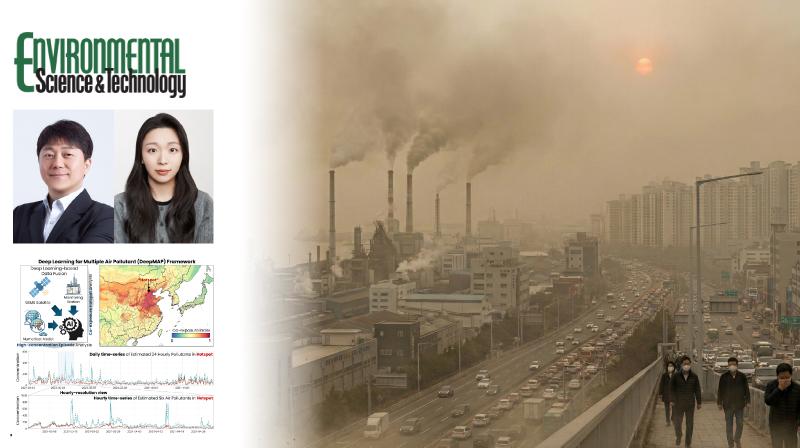
UNIST Unveils AI-Driven Framework for Real-Time Multi-Pollutant Air Quality Monitoring